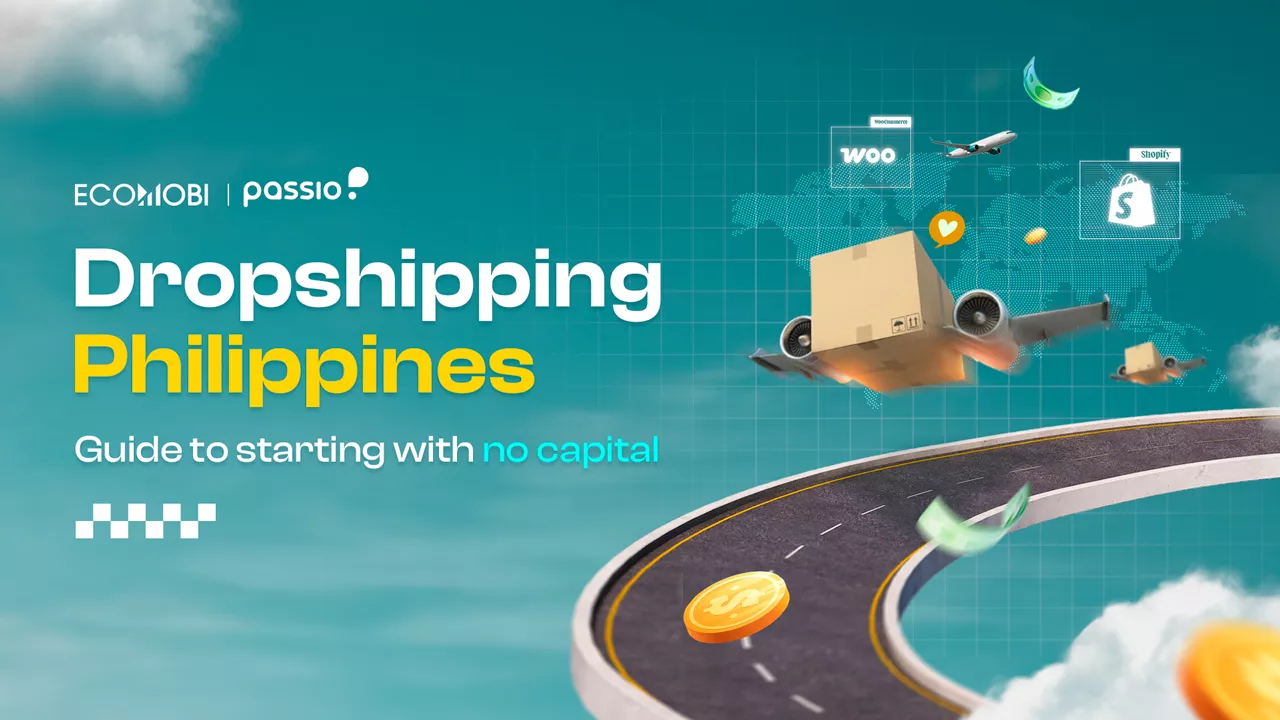
Starting a dropshipping business in the Philippines in 2026 is one of the most accessible paths to online income – but only if you adapt to how Filipino buyers actually shop. With the Philippines posting a 23% ecommerce growth rate (the highest in the world), the opportunity is real. This guide gives you the exact blueprint: the right platforms, suppliers, COD setup, legal requirements, and marketing strategy to build a profitable dropshipping business in the Philippines from scratch
Key takeaways:
- The Philippines is the fastest-growing ecommerce markets in Southeast Asia (with a CAGR of around 11 – 13.7%).
- Over 87% of Filipinos shop online via smartphone – mobile optimization is non-negotiable.
- 68% of Filipino buyers prefer Cash on Delivery (COD); you must offer it to compete.
- Return-to-Origin (RTO) rates on COD orders can reach 20 – 40% logistics management is your #1 profitability lever.
- Starting costs range from ₱0 (TikTok Shop organic) to ₱5,000 (Shopify + ads) – capital barrier is low.
- The “Local-to-Local’ model (PH warehouse suppliers + COD) outperforms China-shipping dropshipping 3:1 in PH.
What is dropshipping business and how does it work?
A dropshipping business is an e-commerce retail model where the seller does not keep products in stock. Instead, when a customer buys an item, the seller purchases it from a third-party supplier (usually a wholesaler or manufacturer) who then ships it directly to the buyer.
In the dropshipping Philippines context, you act as the middleman between Filipino consumers and local or international warehouses. You earn a profit on the price markup without ever touching physical inventory. Unlike traditional reselling, you never purchase products upfront.
The dropshipping model follows three steps:
- Customer order: A customer purchases an item from the retailer’s online store at a set retail price.
- Order forwarding: The retailer (you) forwards the order details and pays the supplier the wholesale price for the item.
- Fulfillment: The supplier packages and ships the product directly to the customer, often under the retailer’s name to ensure a unified brand experience.
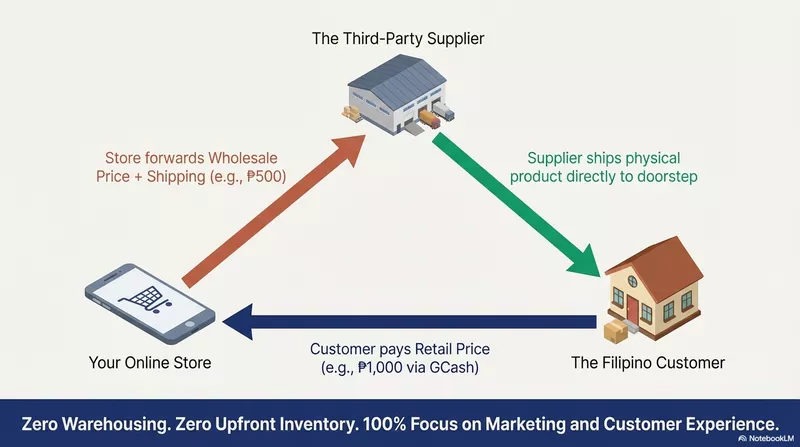
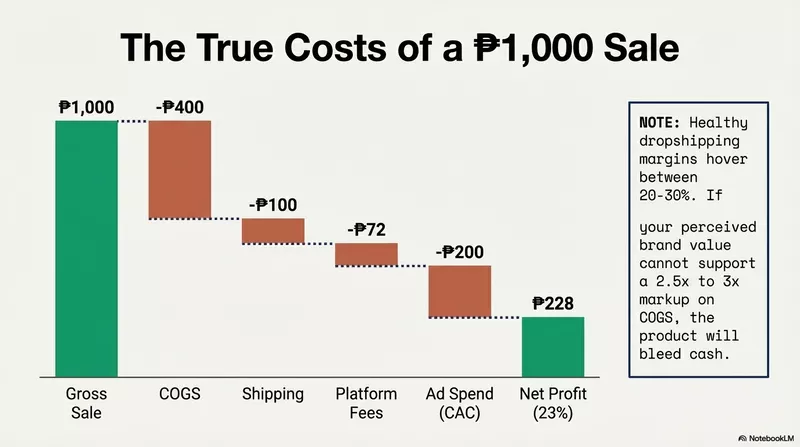
The retailer’s profit = retail price – wholesale cost – platform fees – marketing costs. Typical margins in the Philippines range from 20% – 50% depending on niche, supplier, and platform.
Is dropshipping in the Philippines still profitable in 2026?
Yes – but only with the right model. The dropshipping business Philippines market has hit a new peak due to the rise of social commerce on platforms like TikTok, Facebook, Threads
The Philippine digital economy has hit a new peak, with over 80% of Filipinos shop online using a smartphone (DataReportal’s 2025 Digital Report), making mobile optimization the foundation for every sale.
Generic, price-competing dropshipping is dying; branded, niche, and locally-fulfilled dropshipping is thriving
| Model Type | Profit Margin | RTO Risk | Recommended for PH? |
| Generic China shipping (AliExpress 2 – 4 weeks) | 5 – 15% | Very High (30 – 40%) | Avoid for COD stores |
| International supplier with PH warehouse (CJDropshipping PH) | 20 – 35% | Medium (10 – 20%) | Good starting point |
| Local PH supplier (Dropify, BilisBenta) | 25 – 45% | Low (5 – 15%) | Best for COD model |
| Print-on-Demand (Printful, custom POD) | 30 – 50% | Very Low | Best for branded uniqueness |
| Private label / White label supplements | 40 – 60% | Low | Best for premium positioning |
- In-Demand niches: Top-selling categories include electronics (peripherals and accessories), beauty and health products, furniture, fashion, and toys
- Success factors: Competing on price for generic goods is no longer viable. Success requires selling unique, branded, or high-end items. Print-on-Demand (POD)is frequently cited as one of the best models for the Philippines because it guarantees unique designs.
Pros and cons of Dropshipping Philippines
Pros of Dropshipping
- Low startup costs: You can launch with ₱0 – ₱2,000 on Shopee or TikTok Shop. No inventory, no warehouse rental.
- No logistics management: The supplier handles all picking, packing, and shipping, which eliminates the operational stress of managing a fulfillment center
- Geographical and schedule flexibility: As a 100% digital business, it can be managed from anywhere in the world with a laptop and internet connection
- High scalability: Suppliers absorb volume spikes – you can go from 10 to 1,000 orders per day without hiring staff.
- Easy product testing: You can add or remove products from your catalog with a few clicks, allowing you to test new Philippines niches without the risk of being stuck with unsold stock.
Cons of Dropshipping
- Intense competition: Because the barrier to entry is so low, many sellers often offer the exact same generic products, leading to price wars.
- Limited control: You are responsible for customer service even if the supplier makes a fulfillment error.
- High RTO rates for COD: Return-to-Origin (RTO) rates of 20 – 40% on COD orders can erase your profit margin through double shipping costs.
- Limited quality control: You can’t inspect products before they reach your customer – supplier mistakes become your problem.
- Shipping complexities: International shipping can take 15+ days, which Filipino customers now reject. Shipping costs can skyrocket if a single customer orders multiple items that come from different suppliers.
How much does it cost to start dropshipping in the Philippines?
One of the most-searched questions from Filipino beginners is how much startup capital is actually needed. Here is a full breakdown in Philippine Pesos (₱):
| Expense | Cost (₱) | Optional? | Notes |
| DTI Business Name Registration | ₱200 – ₱500 | No (required once selling regularly) | Register at DTI online or walk-in |
| BIR Registration (Form 2303) | ₱500 annual fee | No (required for BIR compliance) | Needed for GCash/PayMongo merchant access |
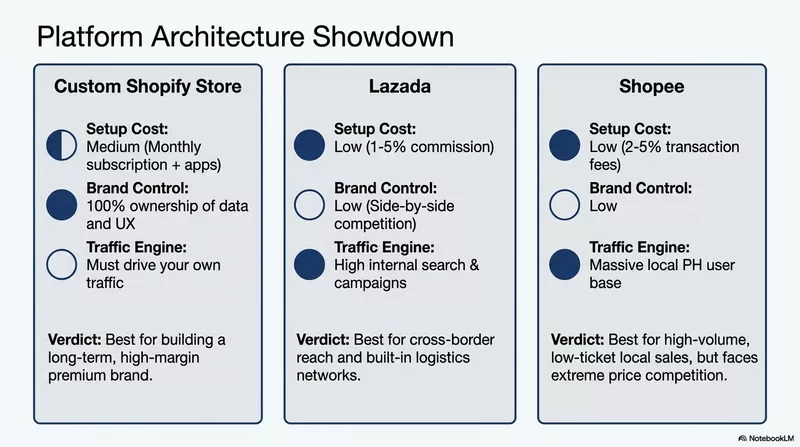
| Shopee Seller Account | ₱0 | Free – recommended starting point | Commission: 1 – 3% per sale |
| Lazada Seller Account | ₱0 | Free | Commission: 2 – 5% per sale |
| TikTok Shop Seller Account | ₱0 | Free — best ‘zero capital’ channel | Commission: 0 – 1% in early launch phase |
| Shopify Plan (Basic) | ~₱1,560/month | Optional (for brand-first strategy) | Best for long-term brand building |
| Initial Ad Budget (optional) | ₱500–₱2,000 | Optional (organic-first is possible) | TikTok organic = near-zero spend option |
| Product Sample Testing | ₱300–₱1,000 | Highly recommended | Order before listing – non-negotiable vetting step |
| TOTAL RANGE | ₱0–₱5,000 | — | Marketplace-first model starts at near zero |
How to start dropshipping Philippines: The 2026 6-Step Blueprint
Starting a dropshipping business in the Philippines requires a localized approach to address unique market challenges like the preference for Cash-on-Delivery (COD) and intense competition.
Step 1: Research a profitable local niche for the PH market
The foundation of your business is identifying a niche with high demand but lower competition.
- Avoid broad categories dominated by Lazada and Shopee’s own sellers. Use Google Trends (filtered to the Philippines), TikTok Creative Center, and Shopee’s search suggestions to find underserved segments.
- Focus on “deep niches”: instead of “electronics”, sell “wireless earbuds for commuters in Metro Manila”.
- High-demand 2026 categories: Beauty and personal care tools, pet care essentials, kitchen organizers, Health & Wellness, and print-on-demand lifestyle products.
Step 2: Find and vet Suppliers
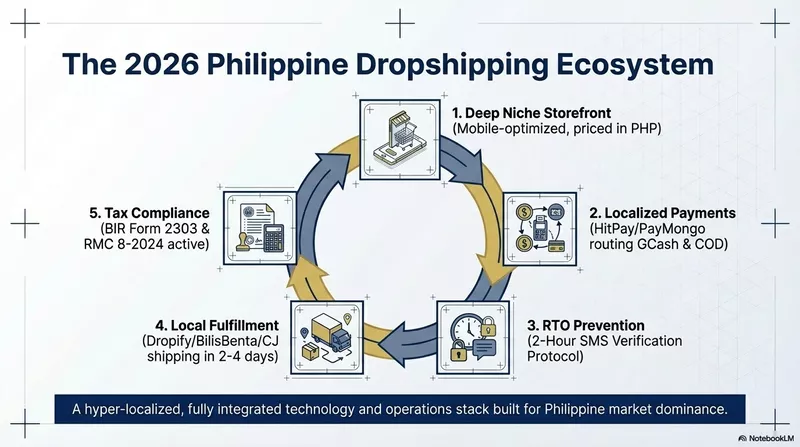
The #1 killer of PH dropshipping stores is long shipping times. In 2026, Filipino customers expect their orders within 2 – 4 days.
- Filipino buyers expect delivery in 2 – 4 days. Prioritize suppliers with Philippine warehouses:
- Dropify PH (COD-native, 1 – 3 day delivery)
- BilisBenta (50,000+ products, Lazada/Shopee integration, 1 – 5 day delivery)
- CJDropshipping PH Warehouse (trending items, Lazada/Shopee API).
- Always order product samples first to personally evaluate quality, packaging, and fulfillment timelines before selling to customers.
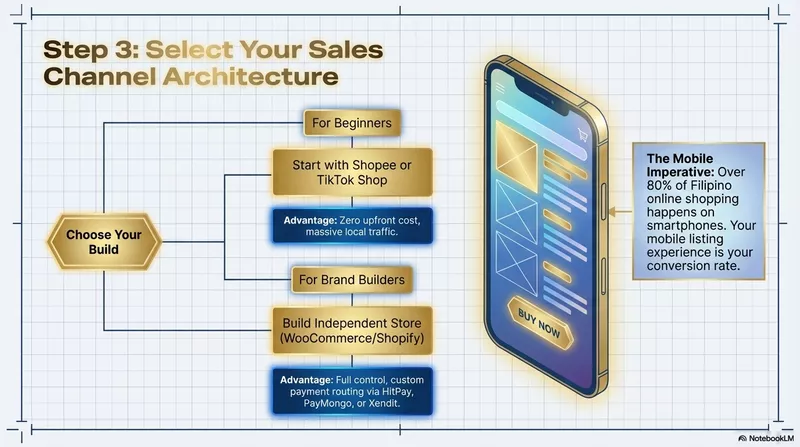
Step 3: Select a Sales channel and build your store
- For beginners: start with Shopee or TikTok Shop (zero upfront cost, massive local traffic).
- For brand builders: use WooCommerce/Shopify Dropshipping with HitPay, PayMongo, or Xendit to enable GCash and COD.
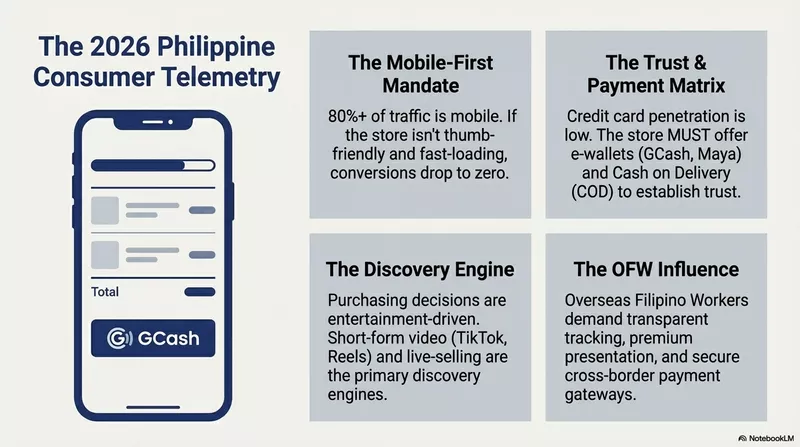
- Tip: over 80% of Filipino online shopping happens on smartphones – your mobile listing experience is your conversion rate.
Step 4: Configure localized payments
To succeed, you must offer:
- Cash on Delivery (COD): Still the preferred method for 68% of Filipinos.
- Enable GCash and Maya via Dragonpay, PayMongo, HitPay, or Xendit for Shopify stores (Essential for the 80% of the population using digital wallets).
- Currency: You must price all products in Philippine Pesos (PHP). Filipinos are generally averse to seeing prices in US dollars, which they often perceive as “expensive” regardless of the actual cost
Step 5: Legal and Tax registration
While you can start informally, the government requires online sellers to register once they sell regularly
- DTI Registration: Register your business name (approx. ₱200+).
- BIR registration: You must register with the Bureau of Internal Revenue (BIR), obtain a Certificate of Registration (Form 2303), and pay a ₱500 annual fee.
- Withholding tax: Under RMC 8-2024, e-marketplace operators will withhold a 1% tax on half of your gross remittances if your annual earnings exceed ₱500,000.
Step 6: Launch and market your store
Marketing is the primary engine for dropshipping growth
- Social Commerce: Leverage TikTok Shop, Facebook, and Instagram Reels. Filipinos frequently purchase items they encounter through short-form video entertainment and influencer content
- Order verification: To combat high RTO rates for COD orders, implement a verification system, such as an automated SMS confirmation or phone call, within 2 hours of order placement.
Top 5 hottest dropshipping products for Filipinos
Identifying the best products for the Philippine market requires a strategy that avoids direct price competition with giant wholesalers and Chinese manufacturers who dominate generic goods.
Top profitable and in-demand products for dropshipping business Philippines include:
- Electronics peripherals & Mobile accessories: Phone chargers, multi-port hubs, wireless earbuds, laptop stands. Filipinos are among the world’s heaviest social media users – mobile accessories have year-round demand.
- Print-on-Demand (POD) custom products: Custom-designed t-shirts, phone cases, mousepads. POD guarantees uniqueness – your products cannot be undersold by Chinese manufacturers on Shopee.
- Beauty & skincare tools: LED face masks, guasha tools,… Focus on middle-to-upper market; Filipinos show strong brand loyalty in beauty.
- Health supplements (White Label): Private-label food supplements are one of the highest-margin niches in PH. Filipinos have a strong affinity for health products, and white-label gives you brand control.
- Home, Kitchen & Niche hobby products: Kitchen organizers, solar lights, gaming peripherals, anime/fandom merchandise. These ‘deep niche’ categories have loyal buyers and low price competition.
>>> Discover more exclusive and high-demand niches that Filipinos often seek inthis article.
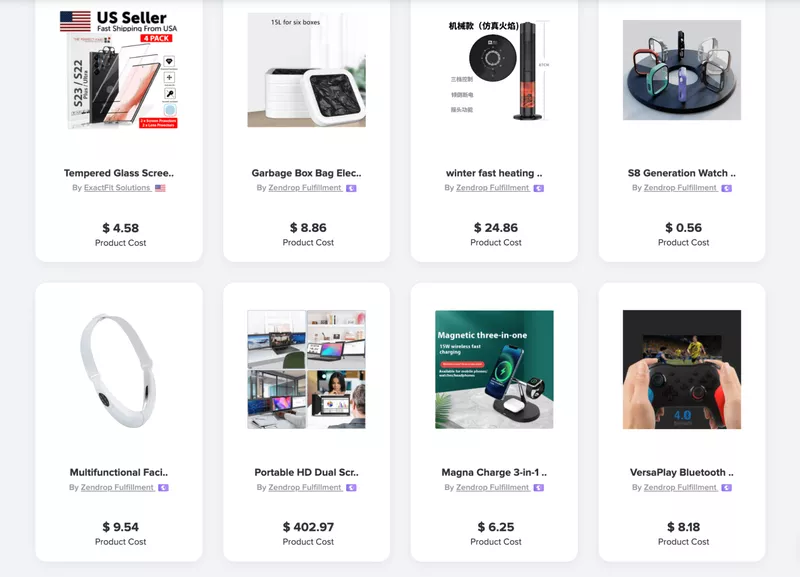
Best dropshipping suppliers in the Philippines for 2026
The “best” platform for dropshipping Philippines depends on whether you aim to build an independent brand or leverage existing marketplace traffic.
- Best for independent branding: Shopify dropshipping is widely considered the preeminent platform for building an independent brand in the Philippines.
- Best for local reach: Lazada and Shopee: Ideal for cross-border sales across six Southeast Asian countries. TikTok Shop: Increasingly popular for impulse buying and viral marketing, especially in beauty and electronic
- Best suppliers and integrations by Niche (detail here):
| Supplier | Shipping Time (PH) | COD Support | Best For | Platform Integration |
| Dropify PH | 1 – 3 days (Metro Manila) | COD-native | Beginners, COD-heavy model | Lazada, Shopee |
| BilisBenta | 1 – 5 days | COD-ready | High volume, automation | Lazada, Shopee, Shopify |
| CJDropshipping (PH Warehouse) | 3-7 days | Supported | Trending products, scale | Shopify, Lazada, Shopee |
| AliExpress (ePacket) | 10-20 days | Not supported | Low-urgency, unique items only | Shopify (DSers, AutoDS) |
| Printful / Print-on-Demand | 7-14 days intl. | No COD | Branded, unique designs | Shopify, WooCommerce |
| Local Wholesalers (Divisoria/Binondo) | 1-3 days | COD-native | Niche local products | Custom integration / manual |
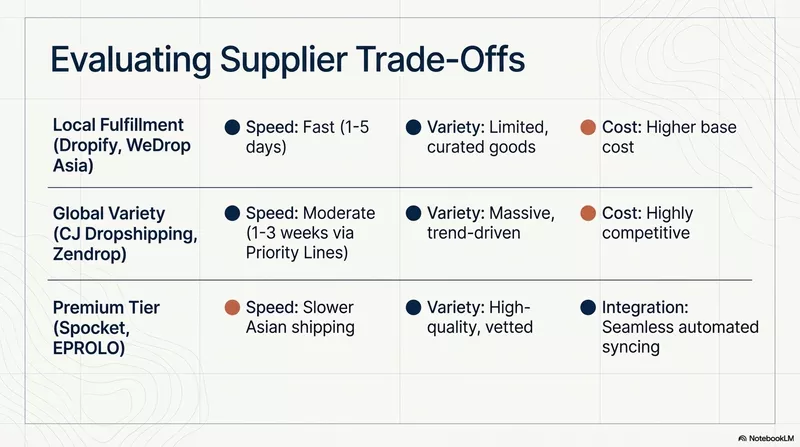
Important note: Start with Dropify or CJ Dropshipping paired with Shopee for optimal local delivery and low returns; they’re ideal for PH’s COD-heavy market. Test small orders first and focus on high-demand niches like beauty or gadgets.Specific challenges in the Philippine market
What are the unique challenges of Dropshipping Philippines?
If you are operating in the Philippines, additional unique hurdles exist:
- Competition with Chinese suppliers: Many Chinese manufacturers rent warehouses in the Philippines, allowing them to sell the same items at a much lower price with faster local shipping.
- Logistics and RTO: The archipelago’s fragmentation across 7,000+ islands complicates shipping. RTO rates for COD orders can reach 20% – 40%, which can devastate profit margins due to double shipping costs
- Payment preferences: 68% of Filipino shoppers prefer COD. While digital wallets like GCash are used by over 80% of the population, only about 8% have credit cards, making standard international payment integrations difficult.
- BIR compliance: Under RMC 8-2024, e-marketplace operators withhold 1% tax on 50% of gross remittances for sellers earning over ₱500,000/year. Registration is mandatory. If you’re not registered with DTI and BIR, you can’t access proper local payment gateways like GCash, Maya, or PayMongo. You’re stuck with PayPal – which your market probably doesn’t even know how to use.
Read more:
Scaling your business with Ecomobi
This is where you move from a “one-man shop” to a dominant e-commerce player. Ecomobi offers a suite of tools that align perfectly with the 2026 dropshipping model.
- The hybrid model: Don’t just dropship; act as an affiliate too. Use Ecomobi to find high-commission products that you don’t even need to list on your store.
- Traffic management: Use Ecomobi’s links on your TikTok and Instagram profiles. This allows you to redirect “window shoppers” to your top-converting products across different platforms.
- Influencer collaboration: Ecomobi connects you with thousands of micro-influencers in the Philippines who can review your dropshipped products, providing the “social proof” that Filipinos crave.
Before you commit to dropshipping, many successful Filipino online sellers actually start with affiliate marketing first. Why? Because dropshipping still requires capital for supplier samples, platform setup, and ad testing. Affiliate marketing – where you earn a commission by promoting someone else’s products – requires zero inventory and zero upfront cost. Once you’ve validated which products your audience actually buys through affiliate sales, you can graduate to dropshipping those exact products with confidence
FAQ: Dropshipping Philippines
What is dropshipping Philippines?
Dropshipping in the Philippines is an ecommerce business model where you sell products online without holding inventory. When a Filipino customer places an order, you forward it to a supplier – typically one with a local Philippine warehouse – who ships directly to the buyer. You earn the markup between your retail price and the wholesale cost.
Is dropshipping legal in the Philippines in 2026?
Yes, dropshipping is fully legal in the Philippines. However, once you sell regularly, you are required to register your business name with the DTI (₱200 – ₱500) and register with the BIR (₱500 annual fee, Form 2303). Non-registration can result in penalties and blocks access to GCash and Maya merchant accounts
How do I reduce Return-to-Origin (RTO) rates for COD orders in the Philippines?
The most effective tactics are:
– Call or SMS the buyer within 2 hours to confirm order intent – reduces RTO by 30 – 50%.
– Offer a GCash discount to shift buyers away from COD.
– Partner with suppliers like Dropify PH that offer restocking policies for returned items.
– Use local PH warehouse suppliers – 1 – 3 day delivery has 2 – 3x lower RTO rates than China shipping.
How to start dropshipping Philippines for free?
Technically, you need a small budget for platform fees and DTI registration (approx. ₱500). Using TikTok Shop organic traffic is the closest way to start with near-zero ad spend.
What are the best products to dropship in the Philippines in 2026?
The best dropshipping products in the Philippines for 2026 are: electronics accessories (wireless earbuds, chargers), print-on-demand custom items (t-shirts, phone cases), beauty and skincare tools, white-label health supplements, and niche lifestyle products (pet accessories, kitchen organizers, gaming gear).
Which is the best platform for dropshipping in the Philippines: Shopee, Lazada, or Shopify?
For beginners, Shopee or TikTok Shop is best – both are free, have massive local traffic, and support COD natively. For brand builders who want long-term margin control and full customization, Shopify is the best choice. Lazada is best for category-driven browsing and brand-like positioning.
Contact Us:
– Fanpage: https://www.facebook.com/ecomobi.ssp
– Tiktok: https://www.tiktok.com/@ecomobipassiovietnam
– Instagram: https://www.instagram.com/ecomobi.philippines
– Youtube: https://www.youtube.com/@EcomobiAffiliate
– Support: Lidya (Trúc Ly) – Social Seller Development Executive
Zalo: 0937 422 620
Email: lydtt@ecomobi.com
Telegram: @LidyaSoph
WhatsApp: +84 937 422 620