

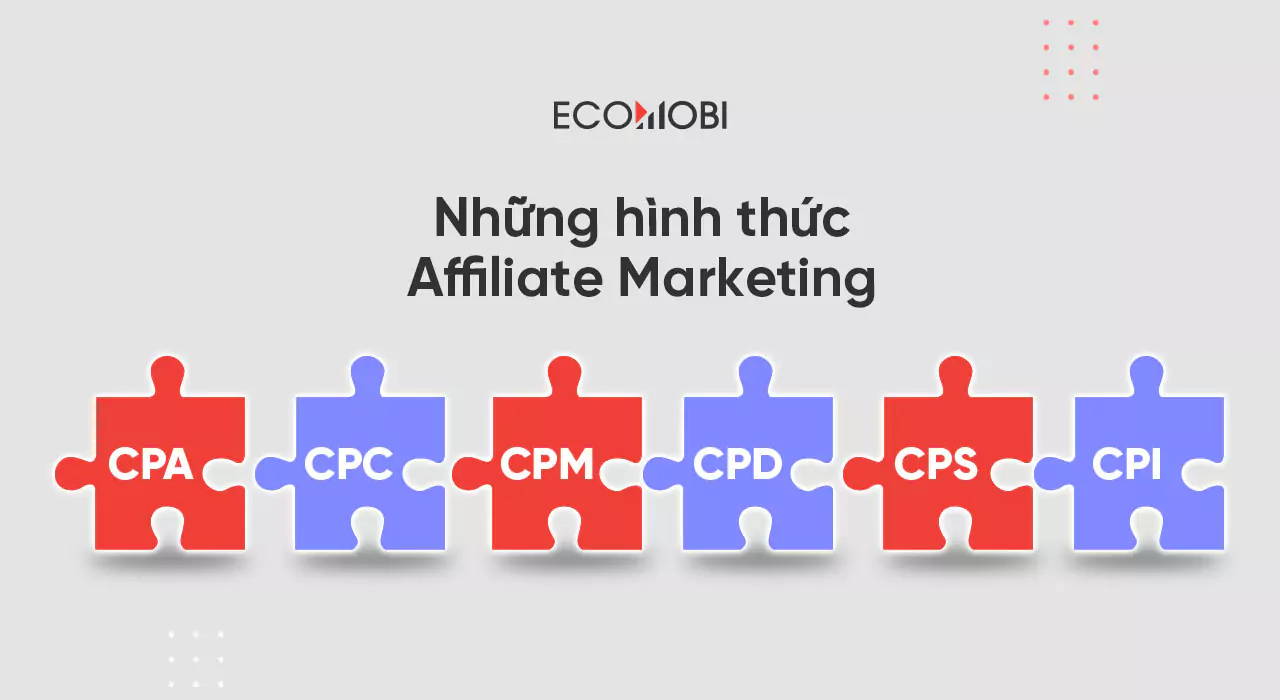
Affiliate Marketing is an effective way to make money but at the same time it is also the easiest way for you to “burn money”. Understanding the terms of Affiliate Marketing will help you make the right and appropriate choices when implementing any affiliate campaign.
General introduction
“CPA, CPC, CPM, CPD, CPS, CPI” are collectively referred to as a group of terms related to payment methods (also known as payment models). Accordingly, for each different product/service, the Advertiser will apply different commission calculation methods for the Publisher.
Affiliate Marketing payment models
What is CPC?
What is CPC? This is the acronym for Cost Per Click – an affiliate marketing payment model in which the publisher receives money for each click on a user’s ad, whether they take the next action or not.

Advantages
- Easy to manage costs: Publishers can calculate costs based on the number of clicks, easily measuring advertising effectiveness.
- If the ad is displayed to people who do not need the service/product, they will not click on the ad ⮕ the advertiser does not pay any fees, helping to optimize the advertising budget (This is also an advantage compared to CPM affiliate marketing).
Disadvantages
- Conversions are not guaranteed: Users may click but not take the desired action.
- High fees: CPC is the most popular form of advertising today, so competition is extremely high. For “hot” keywords or keywords with high conversion and easy revenue, you will have to pay extremely high advertising bids because you compete with many competitors.
- Click Fraud: The risk of receiving bogus clicks from bots or competitors, also known as “clickjacking,” to waste advertising costs.
When to use: CPC is often applied in campaigns that need to increase website visits or attract attention from users (Lead Generation) such as new product advertising campaigns. In case you determine how to guide and angle to stimulate users, CPC will be the most cost-effective with high conversions.
Note: To optimize effectiveness, publishers need to ensure attractive advertising content, target the right audience, and use techniques to avoid click fraud.
What is CPM?
Definition: CPM (Cost Per Mille) is a model in which the publisher is paid according to the number of impressions (usually calculated for every 1,000 ad impressions). For example, in Facebook advertising, your ad is displayed 10,000 times and an amount of 500 USD is deducted, so the CPM is 50 USD (for every 1,000 impressions).
The price per CPM depends on the industry/service of the advertiser, platform, geographical location, and click-through rate (CTR) delivered by the publisher’s website.
CPM calculation formula = (Total amount spent on the campaign ÷ total impressions) * 1000. For example, if the advertising amount is 500 USD and the number of impressions is 50, the CPM is (500: 50) x 1000 = 10 USD.
Advantages
- Increase brand recognition: CPM helps ads reach a large number of users, suitable for branding goals.
- Setting up and launching a CPM advertising campaign is quite easy and you can also estimate costs right from the beginning.
- For publishers, you can earn affiliate commissions even if visitors do not click on the ad. You just need to increase your website traffic high enough.
Disadvantages
- Action is not guaranteed: it is difficult for advertisers to target ads to the right potential customers.
- In cases where ads are placed on websites with low traffic, the ad’s opportunity to reach users will be limited.
- This model does not require users to click or take any action after seeing the ad (As long as your ad appears on the website they are viewing, you will lose money to the publisher).
- High costs with low conversion rates: If ads are not optimized, conversion rates can be very low. For example, people using ad blockers can skip any ads, pop-ups, etc., leading to wasted impressions.
When should you use:
CPM simply means that with every impression, you will lose money, so it is easy to “burn money” without high efficiency. When running campaigns with CPM, publishers need to carefully evaluate the goals of the campaign. If you run a campaign with the goal of driving sales (number of people leaving contact information, number of orders, etc.), then CPM will not be suitable. Instead, CPM is suitable for branding campaigns, increasing customer brand awareness, or promoting new products.
What is CPA?
Definition: CPA (Cost Per Action or Cost Per Acquisition) is a model in which the publisher only gets paid when a user performs a specific action such as: registering an account, watching a video, filling out a form, or downloading a part. application or purchase software,…
Advantages
- Cost optimization: Advertisers only pay when there are specific results, so the efficiency is stricter than CPC and CPM affiliate marketing.
- Easy to track: Easily measure and track customer actions.
Disadvantages
- High costs: Competition between publishers can push up the cost per action.
- Fraud risk: Some publishers may create fake actions to benefit from the payment system.
When should you use CPA?
CPA is suitable for campaigns that require direct conversions like signing up for a service or purchasing a product. If you have a large number of potential customers and your main goal is to drive sales – which can be clearly measured, such as converting 1,000 leads into 100 successful orders, then CPA may be the right choice. However, if the campaign only aims to attract users to sign up for a free product trial, the effectiveness may not be commensurate with the cost.

What is CPL?
Definition: CPL (Cost Per Lead) is a form of Affiliate Marketing payment in which the publisher is paid for each lead (potential customer) collected, such as filling out a form or leaving information (phone number). phone number, email address,…)
Advantages
Generate leads: Help businesses reach customers who have a high likelihood of becoming buyers.
Disadvantages
Lead quality is uneven: Some leads may not be suitable or have no real need.
When to use: CPL is suitable for campaigns that collect customer information, especially in the service, education, or financial industries.

What is CPS?
Definition: With CPS (Cost Per Sale), publishers only receive commissions when users buy products through marketing links – this model is similar to the commission payment model of e-commerce platforms like Shopee Affiliate, Tiktok Affiliate, Temu Affiliate,…
Advantages
Safe for advertisers: They only pay when there are actual sales, minimizing the risk of advertising costs (different from CPA – users can click on the link but are not sure to make a purchase)
Disadvantages
- Long conversion time: Customers may take time to consider before buying the product, affecting the publisher’s income.
- If a less accurate measurement system is used, advertisers will misjudge CPS effectiveness and easily miscalculate commission costs for publishers.
When to use
CPS is suitable for campaigns with high product value or long-term campaigns such as marketing technology products, software, or premium service packages. Additionally, you need to closely monitor and optimize your marketing content to achieve the best conversion rates.

What is CPI?
Definition: CPI (Cost Per Install) is a model in which publishers receive money when users install applications, software, or other digital content through marketing links.
Advantages
Accurate and clear: This model helps mobile app developers increase installs directly.
Disadvantages
- High cost: The cost of a CPI is not cheap because competition in the mobile application advertising market is becoming increasingly difficult.
- When implementing a CPI campaign, you may encounter a situation where users just download the app but do not engage or use it for long, meaning they do not become “official” users. This can lead to negative feedback rates. The actual install rate is low, negatively affecting the app’s ranking on app stores.
When to use: CPI is suitable for application developers, especially during the product launch phase. However, publishers need to choose campaigns with attractive application content and target the right users to increase installation and usage rates.

What is CPO?
Definition: Cost Per Order is a payment model in affiliate marketing, in which the publisher receives a commission for each order completed through an affiliate link. Unlike CPS (Cost Per Sale), CPO only requires that the order be placed, not taking into account that the customer has paid.
Advantages
- Focus on orders: Easily track performance based on specific orders, helping to optimize campaign performance.
- Less risk than CPS: Since the commission is calculated as soon as the order is created, there is no need to wait for payment.
CPO is often applied to high-end products and services that require thoughtful advice to generate transactions. For example, they will usually be products about interior design, health care, functional foods,…
What is CPV?
Definition: CPV (Cost Per View) is a form of affiliate marketing in which the publisher is paid based on the number of views of a video (usually on platforms like YouTube or Facebook and sometimes newspapers, blogs, etc.). A view will be counted if the following conditions are met:
- On YouTube, a view is counted when a user watches a video for 30 seconds (or the entire duration if the video is shorter than 30 seconds) or interacts with an ad.
- With Facebook, a view is counted when the user stops for at least 3 seconds to watch the video.
Advantages
- Low cost, easy to access: CPV often costs less than other payment models like CPA or CPS, because users only need to view the ad without taking any action. This makes CPV accessible to publishers with limited resources.
- Easy control: The CPV model allows publishers to easily track and measure the number of views, allowing them to adjust their advertising strategies if necessary.
Disadvantages
- No conversion guaranteed: CPV only pays based on views, so even though the ad can reach a large number of users, there’s no guarantee of conversion rate. Having many viewers but not taking specific actions (purchases, registrations, etc.) can reduce the effectiveness of the campaign.
- Low-quality view rate: If the campaign is not targeted to the right audience, it can lead to many views but not from people who are likely to become real customers. This will affect long-term effectiveness and costs may become wasteful.
When to use:
- Branding campaigns: CPV is a great choice for branding campaigns where the main goal is to increase brand awareness rather than generate immediate conversions.
- App advertising: CPV can be very useful when promoting mobile apps, especially when your goal is to increase downloads rather than immediately asking users to take action.
Which affiliate form should publishers choose to use?
When choosing the appropriate affiliate marketing model, publishers need to consider many factors to optimize revenue and campaign effectiveness. Here are some key factors publishers should consider:
Campaign goals
- CPA (Cost Per Action) is suitable if the main goal is to create specific actions from users such as purchasing, registering or filling out information. This model offers high commissions but requires quality traffic.
- CPC (Cost Per Click) is suitable for attracting visits to websites or products, helping to increase brand recognition. Although conversions are not guaranteed, CPC can be a good choice if your campaign wants to drive high traffic.
- CPS (Cost Per Sale) is the ideal choice when the publisher can guarantee direct sales through the campaign. This model requires time to build user trust but offers high commissions for each successful transaction.
Traffic
If the publisher has a large amount of traffic but is not sure about the conversion rate, CPM (Cost Per Mille) may be the right model to make a profit from every 1,000 ad impressions. However, if the traffic is high quality and likely to convert into action or purchase, CPA or CPS will provide better benefits.
User properties
For mobile apps, CPI (Cost Per Install) can be an effective choice if the goal is to get users to install the app. However, publishers need to ensure that these downloads come from users who are truly interested and capable of long-term use, avoiding the situation where there are only installs without interaction.
Transparency and control
The CPA and CPL (Cost Per Lead) models require publishers and advertisers to have close monitoring and transparency in measuring effectiveness to ensure that the actions or leads obtained are valid. This helps reduce fraud and wasted campaign costs.
Industry and product type
CPA and CPL are suitable for high-value products and services such as finance, insurance, or education, where specific actions such as registering or leaving contact information are essential.
CPS is ideal for consumer or technology products where publishers have the ability to generate direct revenue.
Each form of billing in affiliate marketing has its own strengths and weaknesses, suitable for different types of campaigns and goals. As a publisher, you need to clearly understand these models to choose the method that suits your marketing strategy and optimize revenue from campaigns.
Contact us, Ecomobi:
– Fanpage: https://www.facebook.com/ecomobi.ssp
– Instagram: https://www.instagram.com/ecomobi_ssp
– Tiktok: https://www.tiktok.com/@ecomobipassiovietnam
– Email: info@localhost