


AI video output on one major platform grew 417% in a single month – from 12,000 orders in December 2025 to 62,000 by January 2026 (per Vivideo). That’s not the slow, gradual adoption curve typically associated with new technology. 2026 marks a shift from AI Video Creation to AI-powered Content Production, where AI becomes part of Marketing Operations, the Content Supply Chain, and Content Commerce as a whole. This article, Ecomobi rounds up the trends currently shaping the AI video market, and breaks down what they mean for marketing operations and growth strategy through 2026 – 2030.
Summary
- The AI video market is growing fast. Per Fortune Business Insights, the AI Video Generator market is projected to grow from $847 million (2026) to $3.35 billion (2034), at an 18.8% CAGR.
- Image-to-video has become the fastest-growing use case. Instead of generating video from text, businesses increasingly prefer generating video directly from product images to keep brand consistency intact and cut production time.
- AI is shifting from a creative tool to a Content Factory. Enterprise platforms are no longer focused on producing a single video, they’re building a Content Supply Chain capable of automating the entire content lifecycle, from planning to production to performance optimization.
- Creators and AI will coexist. AI boosts creator output, while the human element remains decisive for building trust, storytelling, and conversion.
- AI is now part of the standard video production process. Wyzowl’s State of Video Marketing 2026 report found 63% of video marketers are now using AI to create or edit video, up from 51% the year before.
- For brands, AI Video is no longer a standalone video-generation tool – it’s the foundation of AI-enabled Content Commerce, combining AI, creators, data, and distribution systems to scale content and optimize business outcomes.
5 Market Shaping AI Video Creation trend in 2026
Trend 1: AI Video enters the Scale-up phase
AI video is no longer an experimental technology. Starting in 2025, the market began entering a commercial growth phase as businesses invested heavily in AI-generated video to meet content demand across social media, e-commerce, and digital advertising.
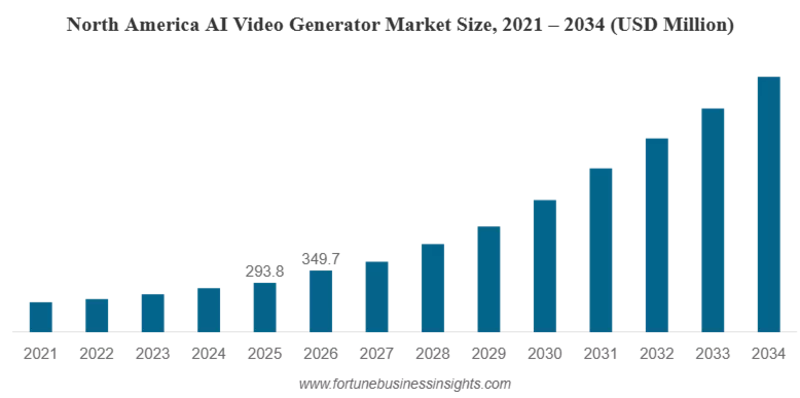
Notably, independent research firms are converging on similar growth trajectories despite using different methodologies. Fortune Business Insights estimates the AI Video Generator market reached $716.8 million in 2025, growing to $847 million in 2026 and a projected $3.35 billion by 2034 – an 18.8% CAGR. Grand View Research, meanwhile, values the market at $788.5 million in 2025, rising to $946.4 million in 2026 and $3.44 billion by 2033, at a 20.3% CAGR (source AI Video Generator Market, 2026–2033).
It’s not just market size that’s climbing, real-world adoption is climbing even faster than revenue. According to Wyzowl’s State of Video Marketing 2026, 63% of video marketers have now used AI to create or edit video, up from 51% the year before. That’s one of the largest year-over-year jumps since Wyzowl began this survey in 2015, signaling that AI video is moving from early adopters into the mainstream.
On Vivideo’s own platform, monthly AI video orders climbed from 12,000 in December 2025 to 62,000 in January 2026 – a 417% month-over-month increase the company attributes in part to the release of Veo 3.1. This is first-party platform data, not a market-wide survey, but it tracks closely with the pace of the broader boom happening right now.
What this means for brands: the AI video market is entering a fast-growth phase, but it’s still early. This is the right moment for businesses to build AI video capability before competition shifts toward scale and operational efficiency.
Trend 2: Image-to-Video is becoming the most important trend in AI Video
This is the shift most “2026 trends” pieces miss and it’s the one that matters most for e-commerce.
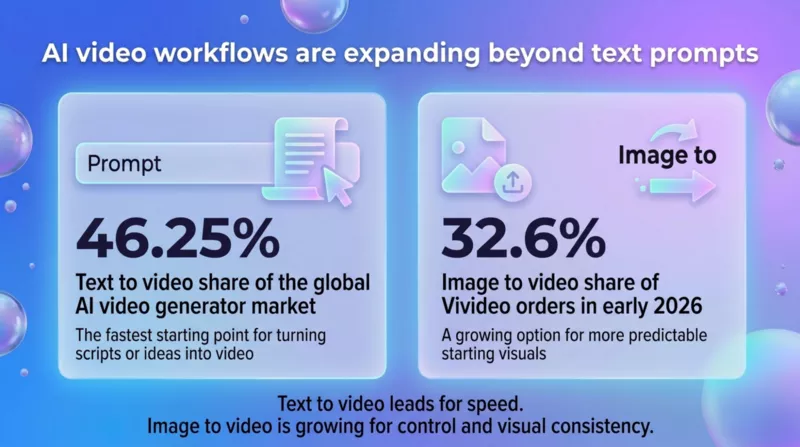
Text-to-video remains the largest segment, since it’s the fastest way to move from idea to concept. But a second current is growing underneath it: image-to-video, which animates a brand’s own product photo instead of generating a new scene from a text description.
Platform data from Vivideo shows image-to-video already accounted for 32.6% of orders in early 2026, versus 65.7% for text-to-video, with a forecast that image-to-video will cross the 40%+ mark as “generate an image, then animate it” workflows get smoother. The reason comes down to control: brands need the exact packaging, label, and color of the product actually for sale, not a “plausible-looking” version a text prompt might invent on its own.
What this means for brands: if your category has strict requirements around packaging, ingredients, or compliance (skincare, supplements, baby products, and so on), prioritize image-to-video starting now. The market is already moving that direction, getting there early avoids having to redo the work later.
Trend 3: AI Video is shifting from a creative tool to a Content Factory
The biggest change in 2026 isn’t video quality, it’s how businesses run their content production process. AI used to mainly assist with individual tasks like scriptwriting or editing. Now, enterprise platforms like Adobe GenStudio, WPP Open, and Microsoft Copilot are moving toward a Content Supply Chain model, where AI participates across the entire content lifecycle, planning, asset creation, workflow management, distribution, and performance measurement.
Note: the figures below (Adobe’s global survey of 3,000 marketing leaders – 69% expecting Agentic AI to support research/analysis/knowledge management, 75% citing data quality as the biggest barrier) were not independently verified as part of my research process. Please confirm the source before publishing.
Adobe’s global survey of 3,000 marketing leaders and practitioners found that 69% of businesses expect Agentic AI to support research, analysis, and knowledge management, while 75% say data quality remains the biggest barrier to deploying AI at enterprise scale.
This shift is also driving the rise of Agentic AI, which lets AI coordinate multiple steps within a single workflow rather than just responding to individual prompts one at a time. What businesses are buying is no longer an AI Video Generator, it’s a system capable of running content production at scale.
What this means for brands: the competitive edge won’t come from producing more videos or owning the best AI video tool. It will come from building a workflow where AI can coordinate multiple stages, from planning through production to performance optimization and from the ability to build a Content Factory that can continuously create, test, and optimize content.
As content volume scales up, managing creators, distributing content across multiple channels, and measuring performance becomes a bigger challenge than producing the video itself.
This is also why the market is shifting from AI Video Adoption toward AI-enabled Marketing Operations, where AI is just one link in the broader revenue-generating process.
Trend 4: E-commerce Becomes the biggest growth driver for AI Video
Among industries applying AI video, Retail and e-Commerce is forecast to be the fastest-growing segment, at a 22.8% CAGR – well ahead of sectors like media, education, or healthcare (source: AI Video Generator Market Size, Share & Industry Analysis).
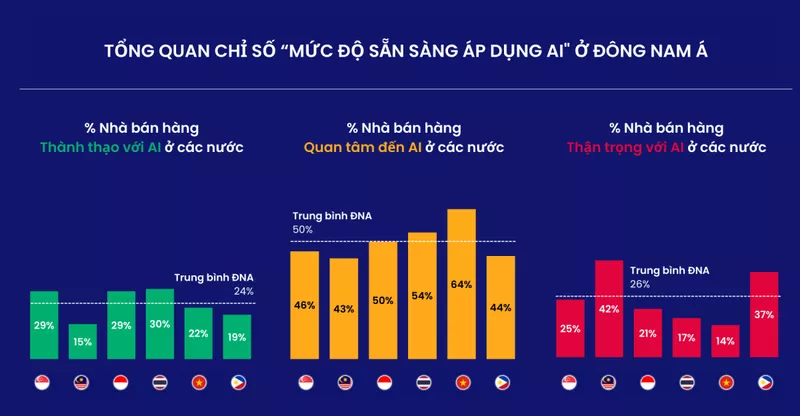
This ranking lines up with what’s happening in Vietnam specifically. Meta and Deloitte’s “AI for Business: APAC” research found Vietnam leading Southeast Asia in SME AI adoption at 93%, ahead of Indonesia (79%), with 66% of Vietnamese businesses using AI for customer communication and 63% for reaching new customers.
Also see: Ecomobi’s three-week AI video pilot for a Mom & Baby brand on Shopee recorded an average conversion rate of 7 – 10% and a GMV roughly 20 times the video production cost.
This trend aligns with the growth of social commerce across Southeast Asia. As TikTok Shop and Shopee increasingly rely on short-form video to attract and convert shoppers, the need to produce hundreds of product videos every month has outgrown what traditional shoot-and-edit workflows can deliver.
Metric’s Vietnam E-commerce Market Report (published January 2026) shows Shopee and TikTok Shop together captured 97% of the 429.7 trillion VND (roughly $16 billion) in combined GMV across four major platforms in 2025, and Metric’s own Q1 2026 forecast points to continued growth of around 33% year-over-year. This trend isn’t confined to Vietnam either, TikTok Shop Indonesia reportedly reached around $13.1 billion in GMV in 2025 per Momentum Works, making it TikTok Shop’s second-largest market globally.
This makes AI video a critical technology for scaling Content Commerce, especially for brands with large SKU counts or frequent seasonal campaigns.
What this means for brands: AI video doesn’t just cut production costs, it solves the problem of scaling content, an increasingly critical factor in social commerce.
Trend 5: Competition is shifting from production speed to quality and trust
As AI makes video production easier, quality and authenticity become the real differentiator.
Research from The Harris Poll, the 4As, and Infillion, unveiled at Cannes Lions 2026, found that:
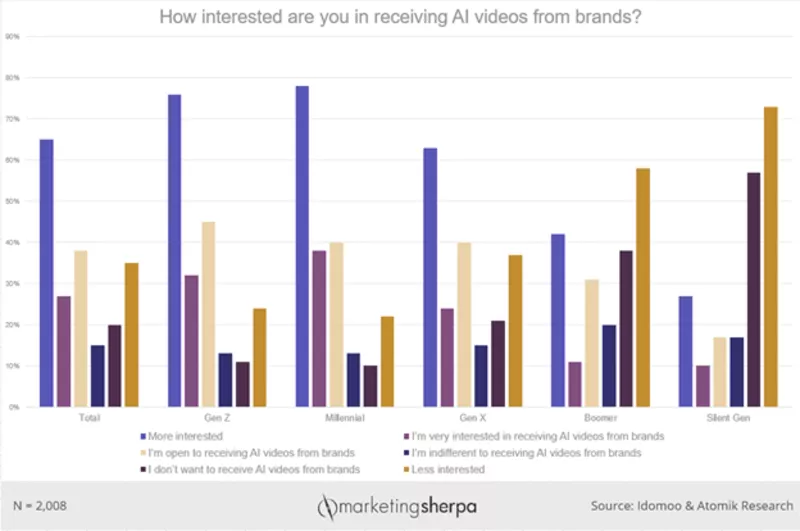
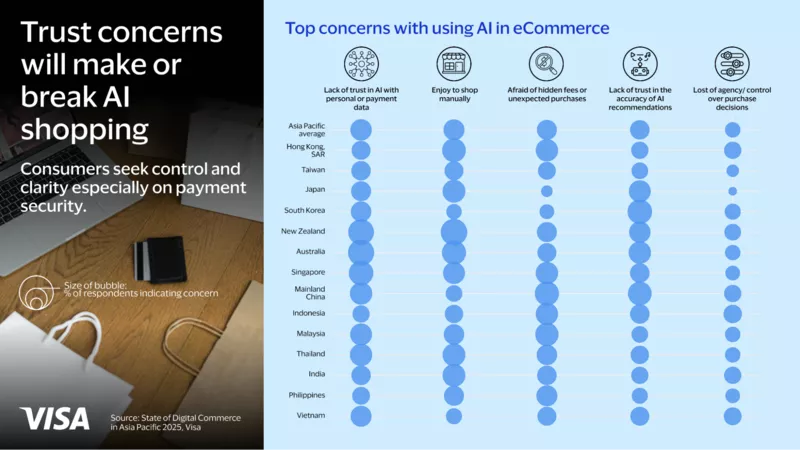
- 78% of consumers say AI makes ads feel less authentic
- 73% say they’d trust an ad less if they suspected it was entirely AI-generated
- 63% say they’d be less likely to buy from a brand using AI-generated advertising.
Alongside this, major platforms like Meta, TikTok, and YouTube have all tightened transparency requirements around AI content to curb deepfakes and misleading material. This suggests the next phase of AI video won’t just be about production speed, it will center on brand governance, copyright, and trust-building.
Regulation is moving at the same pace: Vietnam’s AI Law (No. 134/2025/QH15) took effect March 1, 2026, requiring clear labeling of AI-generated content that could be mistaken for real people or events. An implementing decree (142/2026/NĐ-CP) followed just five weeks later, on April 30, 2026. That fast turnaround signals regulators are actively refining the rules rather than leaving them vague.
What this means for brands: AI video should be used to extend creative capacity, not replace the human element entirely. In the long run, brands that combine AI with real creators, performance data, and quality-control processes will hold a more sustainable advantage than brands chasing content volume alone.
The KPI Shift: What should CMOs measure instead of “Cost per Video”?
Marketing teams used to ask a simple question: “How much does it cost to produce one video?” But now that AI can generate a video in minutes, cost per video no longer reflects competitive advantage.
According to Gartner, as AI automates more execution work, businesses should shift focus from production cost toward the ability to create and optimize content at scale. The real question becomes: how fast can a business respond to the market, and across how many customer touchpoints can it show up?
Per Gartner, businesses are starting to add new metrics:
| Traditional KPI | Next-Gen KPI |
|---|---|
| Cost per Video | Creative Velocity (idea-to-publish speed) |
| Video Volume | Content Coverage (share of SKUs with video) |
| Production Time | Testing Speed (number of variants tested) |
| Campaign Output | Content Refresh Rate (how often content is updated) |
Instead of only asking “how much did AI save?”, CMOs increasingly care about how many new ideas AI lets them test, how fast they can refresh content, and how far they can scale personalization.
For example, an e-commerce brand with 500 SKUs will struggle to stay competitive producing only 20 videos a month. By contrast, once AI can generate hundreds of video variants from the same set of product assets, the marketing team can continuously test messaging, format, and CTAs to optimize conversion.
That said, AI video doesn’t always deliver outsized ROI. Some 2026 industry analyses citing Gartner data suggest AI video ROI still lags behind other AI marketing applications, largely because review, quality assurance, and brand-compliance processes still require human involvement, while some platforms have also begun tightening distribution of low-quality or obviously synthetic AI content.
What this means for brands: between 2026 and 2030, Creative Velocity will become a metric that reflects a marketing team’s competitiveness, much the way DevOps once changed how businesses measure software development performance.
Where does your brand sit on the AI content maturity curve?
Not every business using AI video achieves the same level of effectiveness. The difference comes down to how deeply AI is integrated into the content production process.
A six-level scale, built on how agencies and platforms describe AI content operations in 2026:
- Traditional Production: the entire shoot-edit-publish process is manual; AI is barely used, if at all.
- AI-Assisted: AI supports individual tasks like scriptwriting, image generation, or editing, but the overall workflow still relies on people.
- AI-Generated: video is generated by AI at scale, particularly for product video, short ads, and social content.
- Workflow Automation: AI is integrated across the process, from ideation and content generation to digital asset management, publishing, and performance analysis.
- Content Factory: the business runs a system capable of continuously creating, testing, and optimizing hundreds of content variants across multiple platforms and audience segments.
- Autonomous Content Operations: AI agents work alongside humans to plan, produce, distribute, and optimize content with minimal manual intervention, while marketers focus on strategy and governance.
What this means for businesses: most companies today still sit at Level 2 or Level 3. Over the next three years, competitive advantage will belong to organizations that can advance to Level 4 and Level 5 – where AI doesn’t just generate video, but runs the entire Content Production System.
Ecomobi’s Perspective: From AI Video to AI-Enabled Content Commerce
Most AI video platforms today focus on producing content faster. But in a social commerce environment, video is only the starting point of the conversion journey. A video only creates value once it’s distributed to the right creator, on the right platform, and continuously optimized based on performance data.
At Ecomobi, AI Video is treated as one component within a broader AI-enabled Content Commerce system, connecting four core capabilities:
- AI Video to scale content production.
- Creator Network to drive authenticity and build trust.
- Affiliate & Social Commerce to distribute content based on performance.
- Performance Intelligence to optimize using data such as CTR, CVR, ROAS, and GMV.
Rather than simply helping businesses produce more videos, the goal is to build a process that can continuously create, distribute, measure, and improve content at scale.
Full-catalog AI video only pays off when it’s tied to real conversion data, not just following the trend. Ecomobi connects AI Video directly to affiliate performance data clicks, CVR, GMV across a network of more than 1,500,000 creators across Southeast Asia, and offers small pilot packages so brands can measure ROI before scaling. [Explore Ecomobi’s Social Commerce Solution →]
Liên hệ với Ecomobi:
– Fanpage: https://www.facebook.com/ecomobi.ssp
– Tiktok: https://www.tiktok.com/@ecomobi.philippines
– Instagram: https://www.instagram.com/ecomobi.philippines